
How Does It Differ From an IRS Offer in Compromise?
A California Franchise Tax Board (FTB) Offer in Compromise is a state-tax version of the IRS Offer in Compromise. It allows eligible taxpayers to settle their state-based tax debts for less than the full balance. Yet an FTB Offer in Compromise program differs in several ways from the IRS’s program; the most notable being that it’s often harder to get approved.
The goal of this blog post is to explain how an FTB Offer in Compromise works, how it differs from the IRS version, and what to expect when you apply. To get help now, contact us about our CA FTB representation services.
Key Takeaways
- The FTB Offer in Compromise (OIC) – It’s similar to an IRS OIC except it’s available in fewer scenarios, applies to state taxes, and is usually harder to get approved.
- IRS and FTB OIC Differences – FTB usually reviews applications faster but may require a collateral agreement. The IRS accepts offers in more situations with more flexible payment terms.
- Collateral Agreements – If the FTB thinks the applicant’s income will increase in the near future, they may require the applicant to pay a percentage of any major income increase over the next five years.
- Professional Tax Advice – It doesn’t always make sense to apply for an FTB OIC, even if you’re requesting a settlement with the IRS. So it’s best to talk to a tax professional when deciding how to resolve an FTB tax debt.
What Is a California Franchise Tax Board Offer in Compromise?
The FTB’s Offer in Compromise (OIC) program allows taxpayers to resolve their FTB tax debts for an amount that’s less than the full tax balance. It’s open to businesses and individuals and designed for taxpayers who don’t have the income or assets to fully pay their unpaid taxes.
The FTB will usually approve an OIC from a taxpayer if the offer is the most the FTB can realistically expect to collect within a reasonable amount of time. To make this decision, the FTB will consider numerous factors, including the taxpayer’s:
- Available equity in assets they own.
- Present income and future earning potential.
- Present and future debts and liabilities.
- Health and age.
- Potential for changed circumstances in the near future.
The FTB is its own tax agency, separate from the IRS, and it evaluates OIC applications independently to consider whether the offer is in California’s best interests.
Applying for a Settlement With the Franchise Tax Board
Taxpayers can apply either online or with a paper application. If applying online, you must use a MyFTB account. If applying with paper, you’ll use one of the following three forms:
- Offer in Compromise Booklet and Application for Individuals (4905PIT)
- Multi-Agency Form for Offer in Compromise (DE 999CA)
- Offer in Compromise and Application for Business Entities (4905BE)
Who Qualifies for a CA FTB Offer in Compromise?
The basic eligibility requirements for a CA FTB OIC include:
- Being current with all required tax return filings.
- Including financial documents like pay stubs, bank statements, and profit and loss worksheets.
- Agreeing with the FTB on the amount of taxes owed.
- Signing and dating the OIC application.
- Not having a current, open bankruptcy.
- Being able to make at least some payment toward the tax debt; the FTB doesn’t accept zero-dollar offers.
CA FTB OIC Vs IRS Offer in Compromise
The primary differences between an IRS OIC and an FTB OIC revolve around:
- The availability of the OIC, when it can be used.
- Down payment requirements with the application.
- The payment structure of the settlement.
- The use of a collateral agreement.
- Decision timeline.
- Required documents for the OIC application.
- Approval probability.
Availability
The IRS accepts OIC offers for three main reasons:
- Doubt as to liability: There’s a genuine disagreement as to the amount of the tax debt or its existence.
- Doubt as to collectibility: There’s a question as to whether the taxpayer has enough money to fully pay their entire tax debt before the expiration of the applicable statute of limitations.
- Effective tax administration: The taxpayer can pay their entire tax bill, but doing so would cause unreasonable economic hardship or be unfair and undermine the public’s confidence that the IRS is administering tax laws in an equitable manner.
In contrast, the FTB basically only accepts OIC requests for doubt-as-to-collectibility reasons – in other words, only when you can’t pay in full.
Down Payments With the Application
When applying for an IRS OIC, the applicant must include a partial payment toward their tax bill. The amount of this payment depends on if they’ve chosen a lump sum or periodic payment option. On the other hand, the FTB doesn’t expect any payment with the OIC application.
Payment Structure for the Settlement
With FTB offers, the taxpayer must pay the entire payment amount in a single payment. However, the IRS allows a lump-sum payment (due within five months of acceptance) or up to 24 monthly payments on a periodic agreement.
Collateral Agreement
A collateral agreement is a contract where the taxpayer agrees to pay a percentage of their future earnings (that exceed a specific threshold) to the FTB. As stated in its Offer in Compromise Book for Individuals, the FTB usually requires collateral agreements if the taxpayer has a potential for significantly increased income within the next five years. The IRS doesn’t require collateral agreements.
Time Required
One of the issues with an IRS OIC is the time it takes to receive a decision. Wait times of up to a year are common, although if it takes longer than two years, it’s automatically accepted.
The FTB is usually quicker to review OIC applications, with a decision coming within four to six months. However, it may take longer for more complex tax cases.
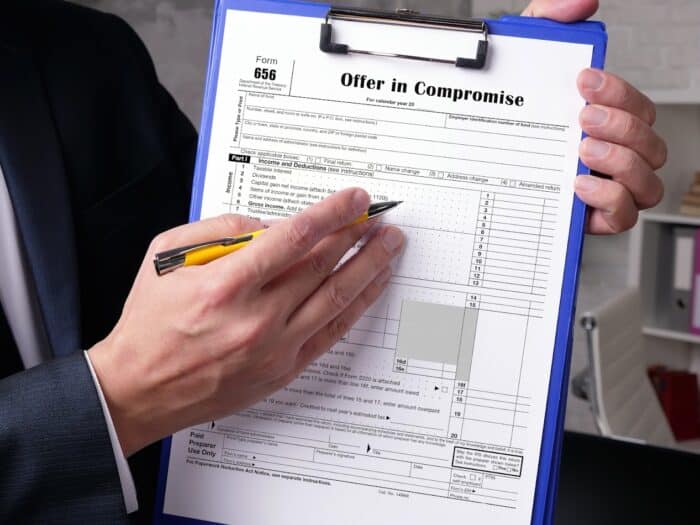
Documents Needed
Both the FTB and IRS require detailed financial information about the taxpayer. However, the FTB can often require more information because it may seek information that relates to California taxes. It should be noted that if you’re applying for an OIC with the FTB and the IRS, the FTB will want a copy of your IRS OIC application (and acceptance letter, if applicable) to go along with your FTB application.
Chances of Approval
It’s typically harder to get an OIC acceptance from the FTB than it is from the IRS. In many cases, the FTB rejects an OIC application from a taxpayer who had their OIC application accepted by the IRS. There are several possible reasons for these differences.
First, the FTB usually has more time to collect back taxes than the IRS (20 years versus 10 years), so they know you have longer to earn the money to pay the tax debt. Second, the FTB places more emphasis on future earning potential, which is why they often require Collateral Agreements. Third, the IRS accepts OIC for reasons that the FTB won’t consider, like doubt as to liability.
| Summary of FTB and IRS Offer in Compromise Differences | ||
| OIC Difference | The Franchise Tax Board | The Internal Revenue Service |
| When an OIC Is Available | Doubt as to collectibility | Doubt as to liability, doubt as to collectibility, and effective tax administration. |
| OIC Payment Structure | No payment included with OIC application, but once approved, lump sum only. | Initial payment required with OIC application, and if approved, the taxpayer can pay in a lump sum or up to two years of payments. |
| Collaterals Agreement | Used if the FTB believes the applicant’s future earnings will go up within the next five years. | Not used |
| Application Review Time | Usually within four to six months. | Up to two years, but often between six and twelve months. |
| Required Information To Apply | Detailed financial information, including OIC application and acceptance information if the taxpayer is also applying for an IRS OIC. California-specific information is often necessary. | Detailed financial information. |
| Chances of OIC Approval | Usually lower than the chances of an IRS OIC acceptance. | Usually higher than the chances of an FTB OIC acceptance. |
What Happens After Applying for an FTB OIC?
After OIC submission, the FTB will confirm receipt within two to four weeks. The FTB then forwards the information to a specialist, who usually takes four to six months to make a decision. Any penalties, fees, and interest will continue to accrue while the FTB reviews the OIC application.
The FTB continues any pending collection enforcement actions during this review, but won’t begin any new collection actions. One exception is if the FTB believes a delayed collection could risk its ability to collect the unpaid taxes from the taxpayer.
If the FTB accepts the offer, the FTB then asks for a lump sum payment, which the taxpayer can make by money order, Web Pay, or cashier’s check. The taxpayer may also need to enter into a collateral agreement with the FTB.
What If the FTB Rejects the OIC?
If the OIC request gets denied, a taxpayer can look into other alternatives, such as a payment plan or installment agreement. Another way to reduce what’s owed is to request one-time penalty abatement. The FTB doesn’t have a lot of taxpayer-facing information about how to deal with a rejected OIC, making it critical to work with an experienced CA tax professional.
When an OIC With the FTB Makes Sense
An OIC should be seriously considered if a taxpayer has few assets or significant sources of income, and this isn’t expected to change for the foreseeable future. This means financially healthy businesses or individuals probably aren’t likely to be accepted. All that being said, it’s best to talk things over with a tax professional familiar with both the IRS and the Franchise Tax Board’s OIC processes.
FAQs: FTB OIC Vs IRS OIC
What does the collateral agreement have to do with future income?
The FTB uses collateral agreements to account for situations where a taxpayer may receive a significant increase in future income. Should this increase occur, the collateral agreement requires the taxpayer to pay a percentage of the increase to the FTB.
Will an IRS OIC acceptance help increase my chances of an FTB acceptance?
No, as the FTB conducts its OIC examination completely independently from any offer submitted to the IRS.
How long will it take for the FTB to review my OIC request?
The FTB usually makes a decision within four to six months after your tax account has been forwarded to a specialist.
Will applying for an OIC with the FTB pause any collection actions?
Applying for an OIC doesn’t automatically stop existing collection actions, but it will usually prevent a new one from starting while the FTB reviews your offer.
Can you settle sales tax debt in California?
The California Department of Tax and Fee Administration (CDTFA) may agree to settle sales tax debt for less than owed, but generally only if the business is no longer operating, the tax debt was assessed against an individual who can’t pay, or a new owner inherited sales tax debt.
Can you settle employer payroll taxes in California?
The California Employment Development Department (EDD) will only let you settle payroll taxes if the business is no longer operating or if an individual can’t afford to pay EDD taxes that have been assessed against them personally after a business didn’t pay.
Get Professional Help With a CA FTB Offer in Compromise
The FTB OIC application process can take a lot of time and effort to complete. Once you apply, the FTB carefully reviews your financial information, including your future earning potential. Any missing information or inconsistencies can lead to delays or denials. Therefore, it’s critical to seek guidance from a tax pro for the application process and in deciding if an OIC should be considered at all.
Based in California, Tax Network USA’s tax professionals can handle both IRS and FTB OIC applications. If you’re thinking about an Offer in Compromise as an FTB tax relief option, don’t wait to contact us to set up a confidential consultation. We can also help you with the IRS Offer in Compromise program.
Sources
– https://www.ftb.ca.gov/pay/if-you-cant-pay/offer-in-compromise.html
– https://www.irs.gov/payments/offer-in-compromise
– https://www.irs.gov/forms-pubs/about-form-656
– https://www.ftb.ca.gov/forms/misc/4905PIT.pdf