
As a general rule, you only need to file a tax return if you earn a certain amount of money or trigger another filing requirement. But if you’re someone who’s required to file and you don’t do so, you can expect penalties from the IRS. Even if you didn’t earn enough income to file taxes, it may still be worth doing so in certain cases, such as claiming a tax refund.
At Tax Network USA, our tax professionals can provide unfiled tax return help by reviewing your tax situation, explaining your options, and helping you choose a pathway that offers the best possible resolution. Learn how we help with unfiled returns.
Key Takeaways
- Different reasons for filing a return – Taxpayers need to file returns to stay compliant with the tax code, claim a refund, or pay taxes owed.
- The IRS already knows – Due to third-party income reporting, the IRS probably knows about the missing returns.
- Waiting makes things worse – The IRS starts with notices, but may eventually file a Substitute for Return, then begin collection enforcement actions.
- Jail time is unlikely – To successfully prosecute a taxpayer, the government must prove the taxpayer intentionally decided not to file a required tax return.
- Filing a missing tax return is the first step – Until a taxpayer gets caught up on missing tax returns, they’re ineligible for most forms of tax relief.
Reasons to File a Tax Return
There are several reasons why it’s a good idea to file your tax returns. The three most prominent include:
- You have a legal filing requirement: If you earn over a certain amount of income or meet other requirements, the tax code requires you to file a tax return.
- You’re owed a refund: Even if you’re not required to, filing a return may allow you to claim a tax refund.
- You owe taxes: This is the most serious situation because you face problems for not paying your taxes, as well as for not filing your return.
Is There a Time Limit for Unfiled Tax Returns?
The IRS can theoretically go back as far as it wants to assess tax if a taxpayer doesn’t file a required return.
The tax code places limits on the IRS for auditing a tax return (usually three years, up to six years in cases of significant income understatement) and collecting unpaid taxes (10 years). However, Section 6501(c)(3) of the Internal Revenue Code (IRC) states that none of these “clocks” start ticking until the taxpayer files the relevant tax return.
This is why it’s important to stay current with tax filings. If you’re facing tax problems, filing missing tax returns is one of the first steps to getting back on track. It might seem like filing a missing tax return will draw unwanted attention, but in most cases, the IRS likely already knows about the missing return.
The IRS Already Knows About Unfiled Tax Returns
The IRS probably knows about the unfiled tax return because tax information about you has likely been reported to the IRS by third parties. For example, banks, brokerages, employers, and other entities that disburse taxable income often send income data to the IRS.
These reports can take many forms, such as:
- Form W-2
- Form 1099 (such as 1099-MISC, 1099-INT, or 1099-NEC)
- Schedule K-1
Each of these forms identifies a taxpayer, so the IRS expects a tax return from that taxpayer, reporting that income. If the taxpayer doesn’t file a return, the IRS starts sending out unfiled return notices, like CP59 or CP2566.
The bottom line is that the IRS can be aware of unfiled tax returns, but not take action for several months or even longer. Not hearing from the IRS right away sometimes gives taxpayers with missing tax returns a false sense of security.
What Happens If You’re Missing a Tax Return Filing
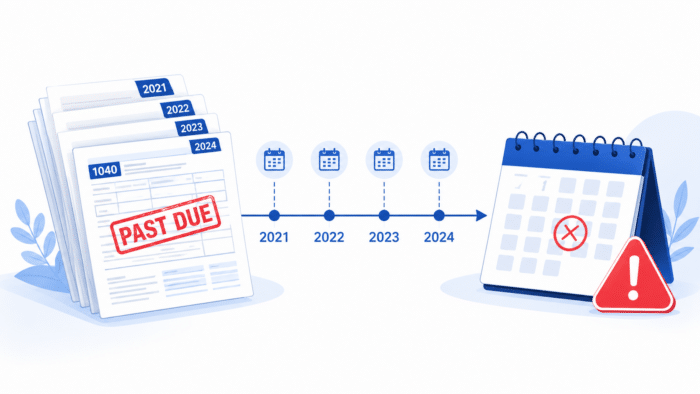
What the IRS does and how long it takes them to act depends on several variables, such as the amount of the potential unpaid tax and how long it’s been since a required tax return was due. That being said, the following provides a general year-by-year timeline of what happens.
| Timeframe | What Happens |
|---|---|
| Less Than Two Years | The IRS sends various notices about the missing tax return, asking the taxpayer to file it or explain why it’s not needed. Once you file, the IRS will apply late filing penalties and interest to the balance due back-dated to the original due date. |
| Three Years | You start to forfeit refunds. You only have three years from the original filing deadline to claim tax refunds. For example, your 2025 tax return is due April 15, 2026, and you have until April 15, 2029, to file it for a refund. |
| Four to Five Years | The IRS may file a tax return for the taxpayer using third-party income information. This is called a Substitute for Return (SFR), which almost always overstates the taxes owed. After preparing the SFR, the IRS may begin unpaid tax collection actions. Be aware that the IRS can take this action at any time, but it usually takes a few years. |
| Six to Nine Years | Once the IRS assesses the tax with an SFR, it can move forward with using more aggressive tax collection tools, such as tax liens, bank levies, and/or wage garnishment. For significant tax debts, the IRS may assign a revenue officer to the case. |
| 10 or More Years | Typically, if the returns had been filed, any taxes owed after 10 years would be wiped away because the IRS’s deadline for collecting those debts expires after 10 years. But this 10-year clock doesn’t start ticking until there’s a tax assessment, and there can’t be a tax assessment until there’s a return. So with unfiled returns after 10 years, you’re in the same spot you were years ago, meaning the IRS can come after you at any point to estimate your liability and start the collections process. |
Can You Go to Jail for Not Filing?
A taxpayer can be criminally convicted for not filing a required tax return, but it’s rare. Of the 61,678 cases reported to the United States Sentencing Commission for the 2024 fiscal year, only 360 were for “tax fraud.”
And not all of these were for unfiled tax returns because tax fraud in this data included offenses such as tax evasion, willful failure to pay taxes, fraudulent returns, and tax advising fraud.
One of the reasons why criminal charges aren’t likely is that prosecutors must prove intentional conduct. Proving beyond a reasonable doubt that someone intentionally chose not to file a return is very difficult to do in most cases, so prosecutors often use circumstantial evidence, such as a taxpayer:
- Having large amounts of earned income;
- Taking steps to hide income; and/or
- Ignoring the IRS’s attempts to contact the taxpayer about missing tax returns.
What To Do if You Haven’t Filed in Years
Once a taxpayer discovers one or more unfiled tax returns, they should talk to a tax professional about their situation. The taxpayer and their tax professional can review the taxpayer’s IRS tax transcript to determine which tax years require returns that were never filed.
The taxpayer should also gather income and wage documents to help calculate reportable income. If these returns indicate significant back taxes are owed, they should still be filed to avoid an even bigger tax bill if there’s an SFR.
Get help with your unfiled returns from our team of experienced tax professionals now.
How Many Years Back Do You Actually Need to File?
In most cases, the IRS will require a taxpayer to file all missing tax returns, but only as far back as six years. The IRS may want to go back further if the taxpayer has a history of noncompliance or there’s a possibility of unlawful conduct.
What Happens After Filing Missing Tax Returns?
The IRS will take about six weeks to process a properly prepared late-filed tax return. Once the IRS has all of the required tax returns, it has three years to audit the return. If the IRS already issued an SFR, the return will replace the SFR, and in most cases, that means owing less than shown on the SFR.
If you owe taxes, you can explore one of these payment or relief options:
- Installment Agreement – monthly payments.
- Offer in Compromise – settlement for less than owed.
- Currently Not Collectible status – collections pause for financial hardship.
You may also be able to use Penalty Abatement to remove some or all of your penalties, which can help to reduce your balance.
FAQ: How Many Years Can You Go Without Filing Taxes
If I’m a W2 employee and missed a year to file, what do I do?
File the missing tax return as soon as you can. Ideally, you should talk to a tax professional to confirm what years are missing and ensure the late-filed return is correctly prepared.
What can I do if the IRS has already filed a Substitute for Return?
You’ll still have an opportunity to file your own tax return to replace the SFR. You must act quickly, though, as your window for doing this can close in as little as 90 days.
Is there a filing deadline for getting a tax refund?
If you’re entitled to a tax refund, you need to file a tax return to claim it. You have three years from the return’s original due date to file for a refund.
Can I go to prison if I misunderstood my tax filing obligations?
No, you can’t be criminally charged if you accidentally didn’t file your tax returns. The IRS won’t prosecute a taxpayer for not filing a tax return that’s the result of an honest mistake.
Can I get into trouble for not filing a tax return if I’m not required to file?
No, but even if you’re not required to file, it’s sometimes in your best interest to do so, such as claiming a refund.
Get Professional Tax Help For Your Unfiled Tax Situation
Whether you forgot to file a tax return, incorrectly assumed it wasn’t needed, or figured the IRS wouldn’t notice if you didn’t file, Tax Network USA can help you resolve your unfiled tax return problem. We have extensive experience handling cases involving multiple years of unfiled returns.
Find out what our unfiled tax return professionals can do for you by calling (855) 225-1040 or using our online contact form.
Sources
- IRS – IRM 5.18.1
- IRS – Filing Past Due Tax Returns
- IRS – Check If You Need to File a Tax Return
- IRS – Who Needs to File a Tax Return
- IRS – IRS Audits
- IRS – Rev. Rul. 2003-88
- IRS – Non-Filer Compliance Alert Notice
- IRS – IRM 4.12.1
- IRS – Time IRS Can Assess Tax
- Taxpayer Advocate – Currently Not Collectible